Passing the AWS Certified Cloud Practitioner Exam
If I were preparing for the AWS Certified Cloud Practitioner today…
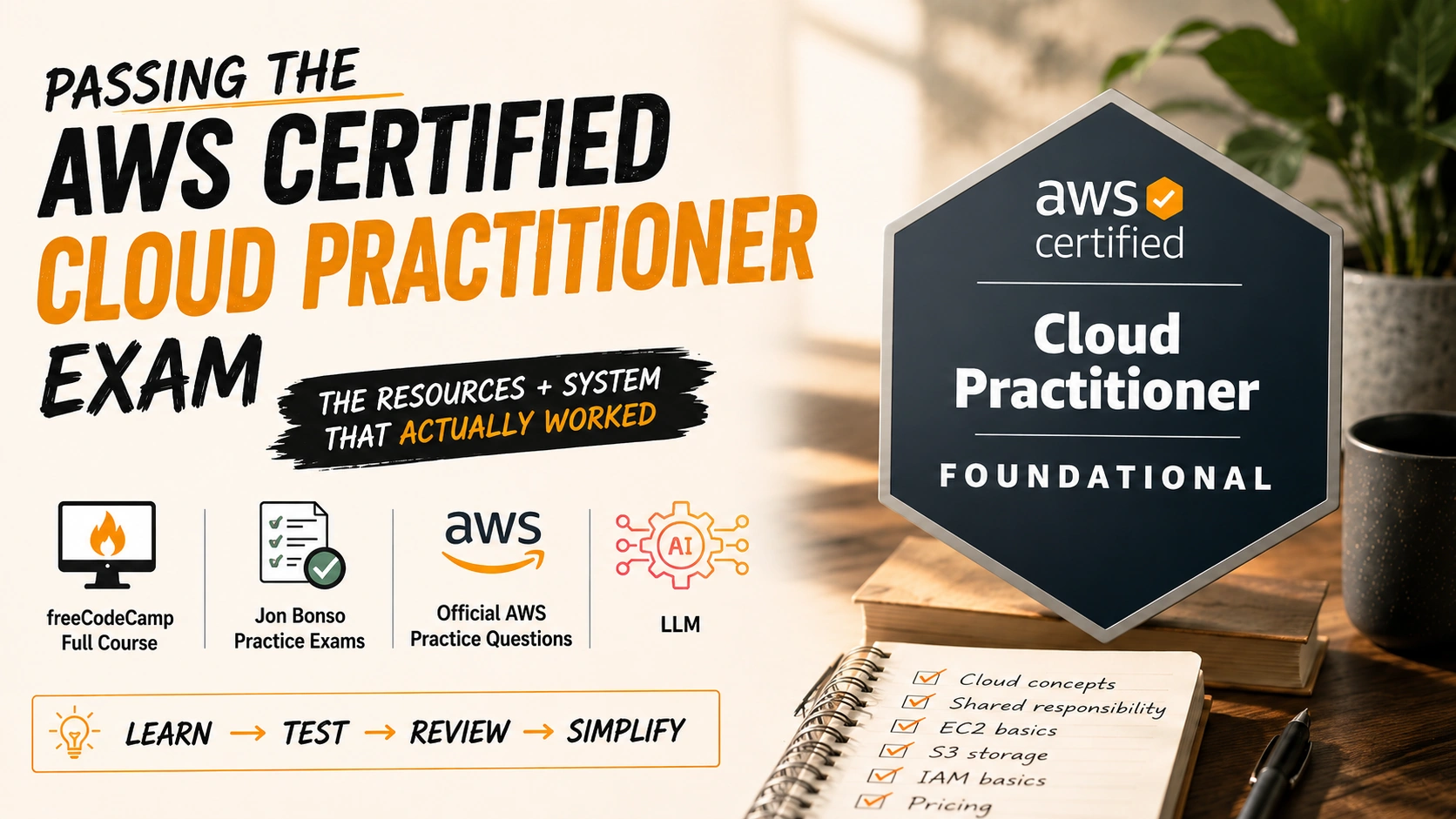
These are the only resources I’d use:
The System
1. Use the freeCodeCamp course as an outline, and use an LLM in parallel as you go through each topic.
Course loop: learn topic -> test/clarify -> simplify -> next topic
2. Take the Official AWS CCP Practice Question Set for the very first benchmark.
3. After each practice exam, review weak areas through Jon Bonso’s topic-based exams.
Testing loop: practice test -> review -> weak area drill -> retest -> repeat
Keep repeating until you can score 80%+ in each domain.
4. Retake the Official AWS CCP Practice Question Set as your final benchmark.
My rule of thumb: 800/1000+ is a strong readiness signal.
If you score below 800/1000, go back to step 3 and focus the weak areas.
If you score 800/1000 or higher, you are probably ready. At that point, do not overthink it.
My Approach
When I passed the AWS Certified Cloud Practitioner exam, the biggest difference was not just the resources I used. It was the system I built around them.
The AWS CCP is an entry-level exam, but that can be misleading. There are still a lot of services, pricing concepts, security ideas, cloud terms, and shared responsibility details to sort through. If you study passively, it is easy to feel like you recognize the material without actually being able to explain it or apply it under exam conditions.
That was the main problem I wanted to avoid. I did not want to just watch a course, take notes, and hope enough of it stuck. I wanted a study process that kept the course active while I was learning, then exposed weak areas quickly once I moved into practice testing.
This is the breakdown of what I used, how I moved through the course, how I used ChatGPT, how I tested, and what actually got me across the line.
Resources I Used
My study stack was straightforward:
freeCodeCamp AWS Certified Cloud Practitioner course
Tutorials Dojo (Jon Bonso) AWS CCP Practice Exams
Official AWS CCP Practice Question Set
ChatGPT (for structured quizzing, review, and reasoning support)
I used the freeCodeCamp course as my main outline. It gave me the broad map of the exam: cloud concepts, AWS global infrastructure, compute, storage, databases, networking, security, billing, pricing, support plans, and the shared responsibility model. That structure helped me move through the material without constantly wondering what to study next.
The Tutorials Dojo / Jon Bonso practice exams became the real testing and feedback layer. That was where I started seeing the difference between topics I actually understood and topics I only recognized.
The official AWS CCP Practice Question Set was also valuable, but I used it later than I should have. In hindsight, I would have used it both at the beginning and near the end of the process because it felt very close to the real exam.
The Study System
The most important part of my process was that I did not use the course, practice exams, and ChatGPT as separate resources. I used them as parts of one study system.
That system had two phases.
The first phase was for moving through the course:
Learn a topic from the course.
Use ChatGPT to test and clarify the topic.
Convert complex topics into simple mental models.
Move to the next topic.
This kept the course from becoming passive. Instead of only watching the material, I used ChatGPT to check my understanding, simplify confusing concepts, and turn important ideas into language I could remember.
The second phase started after the course, when I moved into practice exams:
Take a practice test.
Review weak areas.
Separate true knowledge from lucky guesses.
Use ChatGPT to reason through weak topics.
Convert weak topics into simple mental models.
Retest.
The course is the map. Practice testing exposes areas that require reinforcement.
How I Used the LLM
ChatGPT was not a replacement for studying. It was the tool that made the process engaging and harder to fake.
That distinction matters because it is easy to read an explanation and think, “Yeah, that makes sense.” But recognizing an explanation is different from being able to recall the concept or reason through a question under pressure.
During the course, I mainly used ChatGPT for topic triage, quizzing, and compact mental models. After the course, I used it more for review: breaking down missed questions, clarifying confusing services, and understanding why one answer was better than another.
Topic Triage
This was most useful while I was moving through the course.
When I was studying a service or concept, I would ask ChatGPT to classify how important it was for the exam. The categories were simple: Essential, Less-essential, Optional, and Skip.
“Skip” was rare, but the classification helped me avoid treating every detail equally. That matters because AWS has a lot of services. For the CCP, the goal is not deep implementation mastery. The goal is foundational understanding: what services do, when they are used, and how they relate to cost, security, reliability, and cloud value.
The prompt was very simple — looked something like this:
I am studying for the AWS Certified Cloud Practitioner CLF-C02 exam.

For the topic below, classify its exam importance as:
Essential / Less-essential / Optional / Skip.
Then explain why, and generate a few beginner-friendly exam-style questions.

Topic:
[insert topic]
This helped me allocate attention better. Not every service deserved the same amount of study time. Some topics needed real repetition. Others only needed basic familiarity. That distinction made the process more efficient.
Delayed Reveal Quizzing
During the course, one of the most useful habits was delayed reveal quizzing. Instead of letting ChatGPT immediately explain the answer, I had it ask one multiple-choice question at a time and wait until I committed to A, B, C, or D.
The prompt looked something like this:
Ask one multiple-choice question at a time.

Do not reveal the correct answer until I choose A, B, C, or D.

After I answer, briefly explain why the correct answer is right
and why the other options are wrong.
This kept me honest. When the answer is revealed too early, it is easy to mistake understanding the explanation for knowing the answer. Delayed reveal made me choose before I could benefit from the explanation, which allowed me to better encode the information.
That exposed weak reasoning quickly. Sometimes I got the answer right for the wrong reason. Sometimes I narrowed it down to two choices but could not clearly explain the difference. Sometimes I realized I recognized a service name but did not actually understand what problem the service solved.
That kind of feedback was more useful than just reading another explanation.
Confidence Tagging
Once I started taking practice exams, I did not only mark answers as right or wrong. I also tagged my correct answers based on confidence:
Confident
Unsure
Guessed
This mattered because a correct answer can hide a weak concept. Sometimes I guessed between two options. Sometimes one answer sounded more familiar. Sometimes I eliminated choices without fully understanding the service being tested.
Those answers can inflate the score without proving that the concept is stable. So after each practice exam, I treated “unsure” and “guessed” answers almost like wrong answers.
This made review much more useful because it showed me what still needed work, even when the score looked better.
Compact Mental Models
Compact mental models helped in both parts of the process. During the course, they helped me simplify new topics. During practice review, they helped me rebuild concepts I had missed or guessed on.
These were short phrases or simple explanations that helped me remember what a service does, when it is used, and what it is commonly confused with.
The prompt looked something like this:
Create a compact mental model for this AWS service or concept.

Make it short, memorable, and exam-focused.
Also include:
- what it is
- when to use it
- what it is commonly confused with
- one exam-style clue that points to it

Topic:
[insert topic]
As I questioned each topic, and went through more and more topics, ChatGPT gradually learned to create mental models that are particularly useful for my thinking style.
This was especially useful for services that sounded similar at first. The real benefit came from typing these mental models into my own notes. Thinking about how to write the note forced me to process the concept instead of only reading it.
The typing mattered because it turned review into active recall. I was not just collecting explanations. I was compressing them into language I could actually remember.
How I Used Practice Exams
Practice exams were where the system became measurable. I used Tutorials Dojo / Jon Bonso practice exams to find weak areas and track progress, but the key was not just taking tests repeatedly. The key was using each test as a diagnostic tool.
After each practice exam, I reviewed what I got wrong, what I got right but guessed, what I got right but felt unsure about, which domains were repeatedly weak, and which services or concepts kept showing up. Then I went back into focused review.
The loop became: practice test -> review -> weak area drill -> repeat
This made a big difference because practice exams can be misleading if you only care about the final percentage. A score can go up while parts of your understanding remain weak. Confidence tagging helped prevent that by forcing me to look underneath the score.
Score Progression
Here is what my progression looked like:
First Jon Bonso randomized timed test: 57%
After section-based loops: 74%
After timed practice loops: 78%
After notes and test review: 86%
Official AWS CCP Practice Question Set: 724/1000
Official exam: PASS — 837/1000
The score jump did not come from one magic resource. It came from repeated feedback. The first score showed me where I actually was. The later scores showed that the review loop was working.
By the time I took the official practice exam, I had already improved significantly. But I still think I took it too late. The official AWS CCP Practice Question Set felt very similar to the actual exam, so I would have gotten more value from using it earlier as a baseline and then again near the end as a final readiness check.
What I Would Do Differently
If I could redo the process, I would take the official AWS CCP Practice Question Set twice: once early as a baseline and once near the end as a final benchmark.
That would have given me a cleaner comparison point. Instead of only using third-party practice tests to measure improvement, I would have had an official reference point from the start.
I also would have adhered more to ChatGPT’s topic prioritization judgement, and not over-study low-value details. AWS has a lot of services, with an exam like this it is easy to fall into the trap of trying to memorize everything. For the CCP, the better move is to understand the major service categories, the common use cases, the pricing and billing concepts, the shared responsibility model, and the basic cloud value propositions.
The exam is broad, not deep, so prioritization matters.
What Made the Difference
Feedback.
The course helped me build the foundation. Topic-based practice exams showed me precisely what still needed work. ChatGPT helped me review that feedback, simplify difficult concepts, and turn them into explanations I could effectively encode.
The system kept me asking better questions:
Do I actually understand this?
Can I explain why this answer is right?
Can I explain why the other answers are wrong?
Can I simplify the concept?
My Recommended Study Plan
If someone were starting AWS CCP prep from the beginning, I would keep the plan simple.
First, use a full, free course like freeCodeCamp to build the map. Do not try to master every service on the first pass. The goal is to understand the main domains: cloud concepts, AWS global infrastructure, compute, storage, databases, networking, security, billing and pricing, support plans, and the shared responsibility model.
Second, start using an LLM for simple practice questions earlier than feels. Practice questions are how you find out what “ready” actually means. Do not wait until you feel fully prepared, because the practice itself is part of the preparation.
Third, review intelligently. Do not only review wrong answers. Review guessed correct answers and unsure correct answers too. Those are the areas where hidden weakness lives.
Fourth, turn weak areas into compact mental models that work for you. For each weak service or concept, ask: what is it, what problem does it solve, when would AWS expect me to choose it, what is it commonly confused with, what related services does it usually appear near, and what clue in a question points toward it?
Finally, immediately take the Official AWS CCP Practice Question Set upon completing the course, iterate primarily using Jon Bonsos topic-based exams, and then use the official AWS CCP Practice Question Set as a final benchmark. Use the last review cycle to clean up weak areas before exam day.
Final Takeaway
The AWS Certified Cloud Practitioner is not a deep technical architecture exam, but it is still valuable if you use it correctly.
For me, it was a quick win that helped me build momentum while giving me a clearer foundation around AWS services, cloud value, billing, security, and the shared responsibility model. More importantly, it helped me build a study system I can reuse.
The real lesson was learning how to turn a certification into an active study process.
Originally published on Medium on May 11, 2026.